


Discuss the silent, often unseen war in warehouses and shipping departments everywhere. Not a war with the robots, not over data. A battle against a creeping, suffocating enemy: packing material waste. Plastic bubble wrap mountains. Acres of crumpled paper. Endless plastic air pillows that will be filling landfills, and in some cases our oceans and ultimately our ecosystem too.I t is guilt shared by all who have ever shipped product or received delivery or simply consider the footprint of commerce today.E very time you tear into a box, that rustling symphony of plastic feels less like protection and more like burden. But what if that same thing which protects our precious goods in transit could also protect our planet? This isn’t about some futuristic fantasy.The answer is buzzing away in forward-thinking businesses right now, and it’s called the Air Cushion Machine.
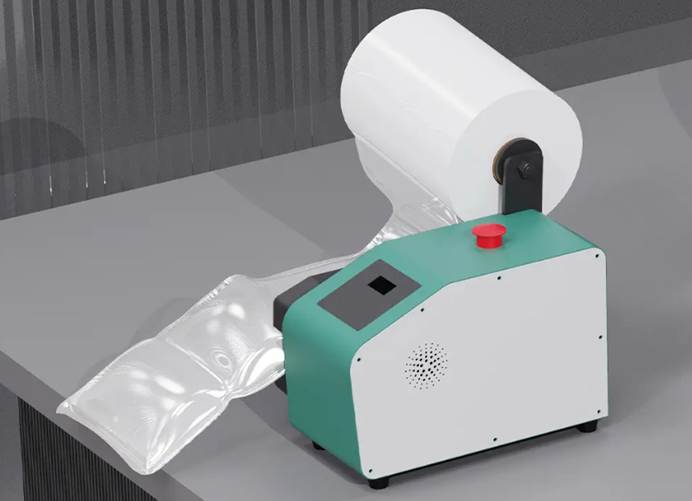
This smart tool is basically flipping the whole packing process. No more depending on ready-made void fill and protective stuff stored in bulk and shipped from across the globe. An Air Cushion Machine makes protection right when you need it, using just a small source. Picture it like a kitchen gadget, but for packaging. You put in a roll of flat, recycled plastic film, and it turns that film into tough, cushioned air pillows or bubble-free barrier layers in moments. The real magic isn’t only in the cushioning—it’s in the huge, almost startling cutback of raw material use and waste. It deals with the issue not at the end but right at the start of the packing process.
Turning Waste into Value
The traditional supply chain for packing materials is surprisingly linear and wasteful. A manufacturer produces giant rolls of bubble wrap or bags of loose fill. These are then packaged again, placed on wooden pallets, wrapped in more plastic, and shipped via diesel-guzzling trucks to distribution centers. From there, they’re shipped again to the business that will actually use them. Every step consumes fuel, generates emissions, and produces its own layer of secondary waste—the pallet wrap, the cardboard skid boxes, the fuel for transport. By the time a roll of bubble wrap reaches a packer’s bench, it already carries a heavy carbon backpack.
A single small roll of flat laminate film that will eventually become tens of thousands of feet of air cushioning arrives at the facility. Since the film is flat, dozens of these rolls take up a space originally occupied by very few pre-inflated pillows or bulky bubble wrap — immediately slashing incoming storage space by up to 90%. But, even more importantly, it destroys the “shipping the air” problem. No longer are you paying to transport empty space encapsulated in plastic; you’re only transporting raw, efficient material. The Air Cushion Machine is now being used as an onsite factory creating exactly what’s needed when it’s needed. That’s a shift from a centralized, bulk-production model to a decentralized, just-in-time creation model. It turns a linear wasteful chain into a smarter localized loop where material efficiency is paramount.
Precision Protection and the Decline of Overpacking
Step through any e-commerce packing station, and you’ll observe a common well-intentioned sin: overpacking. Fragile goes into a box. The packer grabs a handful of loose fill or one sheet of bubble, sticks it in and shakes the box. “Needs more.” Another handful goes in. Safety is the goal, but the method is guesswork based on abundance. This overpacking directly leads to massive material waste. It also makes the shipping more expensive because of dimensional weight and leaves the customer with an overflowing mess to dispose of.
Come, see the Air Cushion Machine—Precision Packing. Many models offer long pillows for bracing and smaller pockets used as dunnage or even continuous sheets applied in a wrapping scenario. This encourages strategic packing. The packer is no longer engaged in mere stuffing but rather engineering a protective cocoon. Perhaps two columns of cushions on either side of the product to prevent it from shifting and a sheet placed on top to be used as shock absorber with a mere dunnage filling the last gaps. Since material is made there, exactly the length can be cut — no more, no less — because plastic usage per box falls precipitously. This is not just waste reduced at the landfill cessation, but waste that never has a chance to become created. The Air Cushion Machine empowers packers to be protective and, at the same time, be parsimonious with material- a duality that is crucial in sustainable operations.
Impact on Waste Management and Customer Service
The effects of the Air Cushion Machine are positive; they ripple out to touch places that one may not include in the calculation. Let us begin by considering the inside of the warehouse. Pre-made packing materials, such as foam peanuts or plastic pillows, come either in many large bags or rolls that are bulky. If a bag is empty, it automatically becomes trash. When a roll of bubble wrap has been used up, its core also turns into trash. These happen to be constant small streams of wastes that require internal handling and bin space and eventual haul away too. The waste from an on-demand system would majorly comprise the empty compact film core from the master roll which happens to be just a fraction of the previous waste stream; compared to before, workspace shall be cleaner with less clutter hence more efficient.
The customer receives the package. A package padded with on-demand air cushions is not the same as receiving one with traditional padding. In general, there is much less material for the customer to deal with. Here is where things are both psychological and environmental: most of these films — if not all — used in Air Cushion Machines are recyclable (typically from LDPE #4) and deflate easily. Just give it a poke or slice it open, and the cushion collapses into virtually nothing, fitting into a recycling bag. Compare that to fighting with a huge, air-filled plastic pillow or layers of some stubborn cling-film-like bubble wrap. This ease of disposal at end-use increases the probability that it will be recycled properly, hence closing the loop more effectively; By using this technology, this brand cares subtly yet powerfully about ‘caring to protect your item but also caring not to burden you with waste.’ It enhances brand reputation while fulfilling increasing consumer demands on sustainability.
Beyond the Cushion: New Materials and Cutting Down Waste
The heart of the waste less fill machines is a reduction at the source. Source reduction is considered the best method in the hierarchy of environmental waste (above recycling and disposal). In plain words, it means using less material from the beginning. The machine happens to be an ultimate tool for source reduction when it comes to packaging. However, innovation doesn’t stop with the mechanics of machine; film itself was also redesigned. There’s a speedy evolution being witnessed by standards in film materials within this industry. Many are now manufactured with high percentages of post-consumer recycled content (PCR)—old plastic given back its life. What’s even more exciting is that some films introduced specifically made for these machines are biodegradable and compostable. Suppose your cushion material after it serves its purpose can break down under industrial composting conditions: no trace left behind; returning back to earth. This changes the protective packing material from a permanent polluter to a temporary helpful implement with a thoughtful plan for its disposal. The Air Cushion Machine becomes the enabler of these advanced materials-allowing for a platform of continuous improvement in environmental aspects without changing the workflow of the packer.
Confronting the Truths and Embracing Change
There is an upfront investment, this requires a change of process and mindset. Machines need to be supplied with power at the packing stations and staff require a few minutes of training-not only on how it operates but also in learning a new more strategic way of thinking about packing. More particularly, some may miss the mindless grab-and-stuff approach. However, when you compute the total cost of ownership, which includes dramatically reduced material purchases, minimized storage costs because materials are no longer stored, boxes that ship better-packed and therefore weigh less (and thus reduce shipping costs), and waste disposal fees-all lowered-immediately makes for a compelling financial argument. It moves packaging from a recurring variable wasteful cost center to an increasingly controlled efficient and sustainable part of operations.
The rustle of plastic does not have to be guilty; it can be a sign of thoughtful intelligent design. This is an Air Cushion Machine, a pretty honest available-now answer to one of the dirtiest little open secrets about e-commerce. It’s proof that sustainability doesn’t require giving up efficiency, that those two things can occupy the same engineered space. This machine, which creates protection out of almost nothing, addresses waste right at the source and speeds up operations while simultaneously delivering a better experience for everyone in the chain — from warehouse managers to the planet itself. Next time you get a package with neat minimal air cushions inside, you’ll know there’s some clever machine working silently away to make sure what protects your purchase doesn’t protect everything else.

