

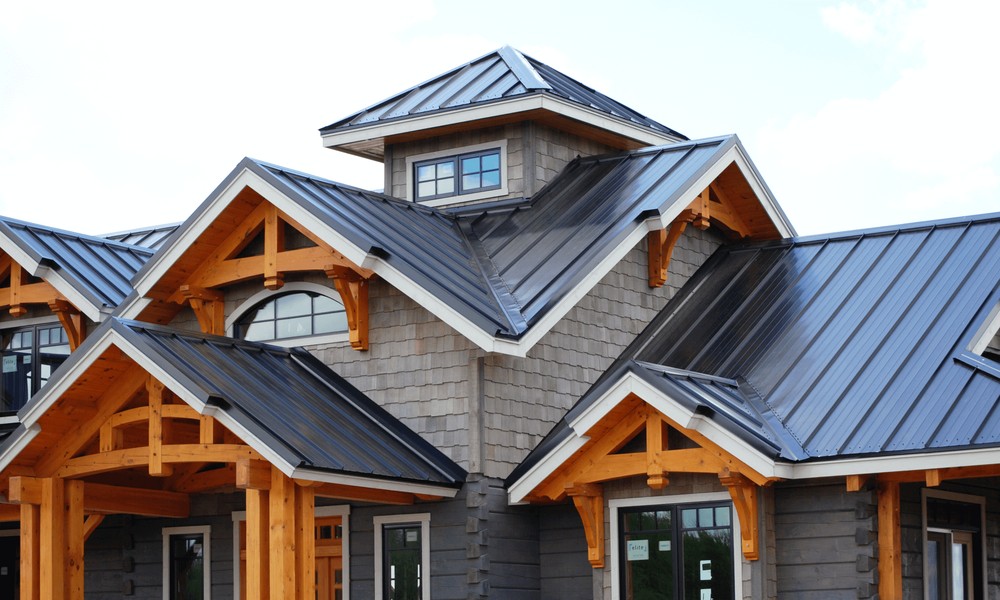

You choose standing seam roofing materials when you need a concealed-fastener, clip-mounted roof that accommodates thermal movement, reduces leak paths, and supports lower-slope designs with tested seam and flashing details. You choose 5V crimp when you want a traditional through-fastened panel that costs less and installs faster, but it needs steeper slopes, precise screw torque, and periodic washer and fastener maintenance to stay watertight. Next, compare cost, uplift ratings, and long-term service demands.
Standing Seam vs 5V Crimp: Key Differences?
Where do standing seam and 5V crimp really diverge? You’ll see it in seam geometry, attachment method, and water management. Standing seam uses raised, interlocking ribs with concealed clips, so you maintain thermal movement and reduce fastener exposure at the weathering plane. 5V crimp relies on lapped panels with exposed fasteners and butyl at sidelaps, so you must control screw placement, washer compression, and the risk of re-tightening to stay code-compliant.
You’ll also contrast practicality across substrates and slopes. Standing seam commonly supports higher-performance assemblies, including tapered insulation and continuous air- and water-barrier systems. 5V crimp favors simpler framing but demands vigilant penetration detailing. For aesthetic impact, the standing seam reads monolithic and modern; the 5V crimp presents a traditional rib pattern with visible fastener lines.
Which Should You Choose for Your Building?
How do you decide between standing seam and 5V crimp for your building? Start with your performance targets and the governing code path. If you need enhanced watertightness for low-slope assemblies, specify a tested standing-seam system with engineered clips, a thermal movement allowance, and documented uplift ratings per ASTM E1592. If your project favors simpler geometry and proven residential detailing, 5V crimp can be used when you keep slope, underlayment, and fastener schedules within the manufacturer’s instructions and local wind zone requirements. You’ll also weigh penetrations: standing seam integrates clamp-on accessories that reduce exposed fasteners. For either profile, require compatible metals, sealed transitions, and continuous ventilation. Capture decisions in drawings to avoid subtopic irrelevance and support two-word discussion ideas.
Standing Seam vs 5V Crimp Cost: Materials and Labor
When you compare standing seam to 5V crimp, you’ll see material pricing shift based on panel gauge, coating system, clip/fastener type, and accessory requirements at eaves, ridges, and penetrations. You’ll also pay different labor rates because standing seam typically requires clip layout, seam closure, and tighter tolerance detailing, while 5V crimp installs faster with exposed fasteners but still must meet manufacturer specs and local uplift codes. To judge true cost, you should account for long-term factors like fastener maintenance, sealant cycles, corrosion resistance, and expected service life under your site’s wind and salt exposure.
Material Price Differences
Material cost differences between standing seam and 5V crimp start with panel complexity and the accessories each profile requires to meet code and warranty conditions. Standing seam panels use heavier-gauge options more often, plus concealed clips, clip fasteners, seam sealant (for hydrostatic specs), and purpose-made ridge, eave, and transition details. That ecosystem shifts price dynamics upward, but it also supports longer weathertight warranties when you follow manufacturer assemblies and testing (ASTM E1646/E2140, UL 580/1897 where specified).
5V crimp typically relies on through-fastened panels, fewer proprietary components, and more standardized trim, so your material outlay stays lower. Still, you’ll budget for gasketed screws, closure strips, and underlayment upgrades to satisfy uplift, corrosion, and water-intrusion requirements. Use two word discussion ideas to compare.
Labor And Installation Costs
Up front, labor is where standing seam often pulls away from 5V crimp, because you’re paying for higher-skill layout, tighter tolerances, and profile-specific tooling that has to meet manufacturer instructions and the roof assembly’s tested wind and watertight requirements. You’ll also budget for clip spacing, panel seaming (snap-lock or mechanically seamed), and QA checks at eaves, valleys, and transitions.
With 5V crimp, you usually install faster with simpler fastening patterns, but you still need disciplined substrate prep, underlayment laps, and correctly placed stitch screws to satisfy uplift tables and corrosion-control details. Don’t buy into installation myths: “any crew can do metal.” If you want paint longevity, you’ll insist on clean handling, no field-abrasion, and correct fastener torque to avoid coating damage.
Long-Term Cost Considerations
Installation cost is only half the story-you’ll also carry the roof’s maintenance, repair, exposure, and service-life performance over decades. Standing seam typically wins on long-term affordability because concealed fasteners reduce leak paths, and engineered clips accommodate thermal movement, limiting oil-canning and fastener fatigue. You’ll spend more upfront, but you can often extend coating life and defer panel replacement with clip retrofits and segmented repairs.
With 5V Crimp, exposed fasteners and lap seams demand tighter maintenance planning: periodic re-torque, washer replacement, and sealant renewal at penetrations. In wind zones and salt air, corrosion at fastener heads can trigger widespread service calls. If you must meet stringent uplift or watertightness criteria, standing seam assemblies have been tested and often reduce lifecycle risk and insurance friction.
Heavy Rain Performance: Minimum Slope and Water-Shedding
In heavy rain, how well your metal roof sheds water comes down to slope and seam geometry-and code doesn’t leave much guesswork. For standing seam, you can typically design to lower slope requirements because the raised, interlocking seams elevate the waterline and reduce back-up risk at panel joints; follow the manufacturer’s tested minimums and align with IBC/IRC roof-covering provisions. For 5V crimp, plan for steeper slopes so capillary action and lap joints don’t trap water at fasteners and sidelaps; most assemblies perform best at 3:12 or greater unless a tested underlayment system allows a lower slope. You’ll also specify underlayment class, sealant locations, and eave-to-ridge drainage paths to keep hydrostatic pressure off seams.
Standing Seam vs 5V Crimp Wind Uplift: What Holds Better?
Why does wind uplift separate some metal roofs while others stay locked down? It comes down to the load path, the attachment method, and the tested assembly ratings. A mechanically seamed or snap-lock stand seam system transfers suction through interlocking seams into concealed clips and the deck, so you can specify assemblies with higher UL 580/UL 1897 or FM 1-90+ ratings when your ASCE 7 design pressures climb.
With 5V Crimp, wind loads concentrate at exposed screws and washers, and fastener exposure increases the chance of progressive loosening under cyclic uplift. You’ll hold better by selecting thicker panels, tighter fastener spacing, and corrosion-rated screws, then verifying uplift tables match your zone (field, perimeter, corner) and substrate. Choose engineered details, not assumptions.
Movement and Oil-Canning: Clips vs Exposed Fasteners
When you specify standing seam, you can use concealed clips that accommodate thermal expansion and contraction while maintaining panel engagement per the manufacturer’s tested assembly. With 5V crimp, exposed fasteners and tight screw patterns can restrain movement, increasing stress at the holes and risking gasket wear or fastener back-out. You’ll also need to account for oil-canning risk factors-panel gauge, width, finish, substrate flatness, and attachment method-because restrained movement and uneven support make visual waviness more likely.
Thermal Expansion And Clips
Although both standing-seam and 5V crimp panels expand and contract with temperature swings, the way each system manages that movement affects performance, appearance, and code requirements. With a standing seam, you’ll typically specify floating clips that let panels slide while maintaining uplift resistance. That controlled thermal expansion reduces seam stress, lowers the risk of distortion, and supports cleaner lines over long runs. Your clip selection-fixed vs floating, stainless vs coated, and spacing-should align with tested assemblies (ASTM E1592) and manufacturer engineering for wind zones. When you compare clips vs screws, clips distribute loads through the seam, not the face, so you can meet performance targets without over-constraining the panel. You’ll also coordinate clip height with insulation thickness, substrate flatness, and seam engagement tolerances.
Exposed Fasteners Restrict Movement
On long roof runs, thermal cycling forces the panel to move, and exposed fasteners tend to pin that movement at every screw point. When you anchor 5V Crimp through the flats, the panel can’t freely float, so stress transfers into the screw shank, washer, and hole edges. That makes detailing and fastening patterns critical for code-compliant performance under wind uplift and diaphragm loads, especially as exposure duration increases.
- Specify oversized holes or slotted fastener locations where permitted, and align with the manufacturer’s ESR guidance.
- Use premium screws with bonded washers, correct torque, and corrosion class matched to the environment for coating durability.
- Control purlin spacing, predrill accuracy, and sealant compatibility to keep joints watertight while allowing micro-movement.
Oil-Canning Risk Factors
Why does oil-canning show up more often on long, sun-exposed metal roof runs? Thermal cycling drives expansion and contraction, and your attachment method determines whether that movement dissipates or telegraphs as visual waviness. With a concealed-clip standing seam, you allow panels to slide within tested clip tolerances, reducing stress concentrations and lowering oil-canning risk. Specify floating clips, correct clip spacing, and substrate flatness per manufacturer and IBC/ASCE wind-uplift approvals, because uneven decks amplify read-through. With 5V Crimp and exposed fasteners, screws pin the sheet at each rib; overdriven washers, misaligned rows, and tight laps lock movement and trigger panel warping. To innovate, you can choose striation, thicker gauge, and pre-engineered clip systems to control aesthetics without sacrificing performance.
Leak Risk and Upkeep: Hidden Seams vs Screw Maintenance
Where do most metal roof leaks actually start-at seams you can’t see or at fasteners you can? With standing seam, you rely on hidden seams and clip engineering; if you spec tested seam height, sealant where required, and proper end-laps, you reduce penetrations and water paths. With 5V Crimp, performance often hinges on screw maintenance: exposed fasteners move with thermal cycling, and washers age under UV.
You’ll control risk by tightening execution and inspection:
- Verify the underlayment class, slope limits, and flashing transitions per code and manufacturer requirements.
- Use calibrated torque and corrosion-matched screws; replace any spun or overdriven fastener.
- Schedule annual walk-downs to catch backed-out screws, deformed pans, and compromised sealant.
Lifespan and Warranty: Gauges, Metals, and Finishes
How long your metal roof actually lasts-and what the warranty will stand behind-depends less on profile than on the full system spec: base metal (steel, aluminum, copper), thickness (gauge), coating (G90/G60 galvanized or AZ50/AZ55 Galvalume), and finish (SMP vs PVDF), all verified to ASTM standards and matched to your exposure category and substrate. Thicker panels resist oil canning, fatigue, and uplift cycling, but only if clips, fasteners, and underlayment meet code and manufacturer details. For coastal or industrial zones, prioritize AZ55 or aluminum and verify cut-edge protection and sealant compatibility. PVDF maximizes color retention and chalk resistance; SMP can meet cost targets while maintaining a shorter warranty. Review warranties for finish, film integrity, and weathertightness separately, and track coating performance with documented maintenance intervals.
Conclusion
You don’t pick standing seam or 5V crimp by looks-you pick by slope, loads, and maintenance. I watched a coastal shop pass a 130‑mph uplift test after upgrading to clip-fastened standing seam; the owner called it “bolting the lid on a storm.” If you need low-slope drainage and fewer penetrations, you’ll like standing seam. If your roof meets the minimum slope and you’ll retighten the screws, the 5V crimp stays code-smart.

